Security
Dutch agencies warn leaders that AI is speeding up cyberattacks
Seven Dutch public bodies have jointly warned that AI is increasing the number, scale and complexity of cyberattacks. The warning is aimed at senior leaders, not only IT departments.
On 24 September the Netherlands' National Cyber Security Centre published a joint warning from seven Dutch public bodies: the National Coordinator for Counterterrorism and Security, the NCSC, the General Intelligence and Security Service, the Defence Intelligence and Security Service, the Public Prosecution Service, CIO Rijk and the Police. NL Times independently reported the warning and the participating agencies the same day.
Their assessment is that AI is increasing the number, scale and complexity of cyberattacks, lowering the barrier for a broader range of attackers and helping identify and exploit vulnerabilities faster. The statement says attackers do not need the most advanced frontier models: existing, readily accessible models can automate, accelerate or improve attack techniques. This is the agencies' assessment rather than a new quantified experiment.
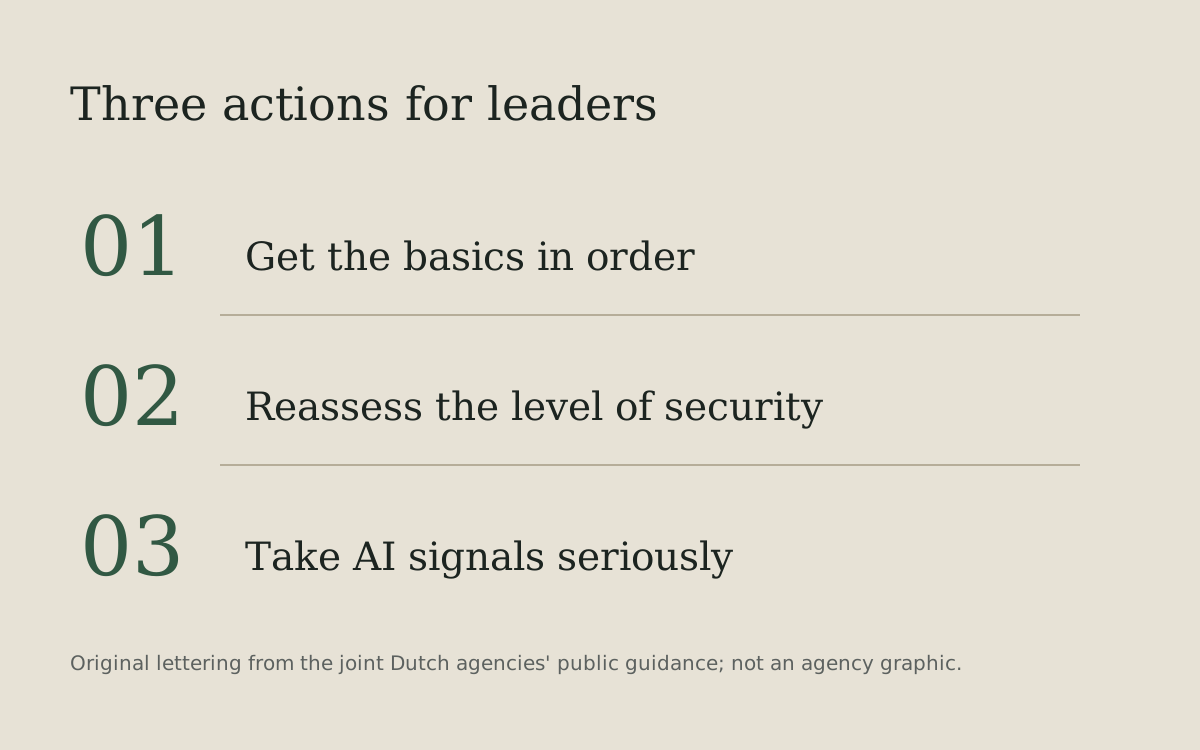
The agencies give three immediate actions: get basic security measures in order; ask whether the present level of security is still appropriate; and take AI-related signals seriously. They argue that dependence and interconnection make cybersecurity an organisation-wide governance responsibility, not a matter for IT departments alone.
The publication cites the familiar consequences of weak defences, including prolonged outages of critical systems and theft of names, addresses and Dutch citizen-service numbers. It does not claim that AI caused every such incident. Nor does it announce a specific new attack, a new legal requirement or a measured percentage increase. It is a coordinated public warning and a call to leadership.
Sources: NCSC-NL news, 24 September 2026Joint Dutch agencies' statementNL Times