Infrastructure
Google to test AI chips in orbit on first Suncatcher flight
Google says a prototype satellite carrying its Tensor Processing Units will fly on SpaceX's Transporter-18 rideshare mission. It is a test of whether the chips survive, not an orbital data centre.
On 24 September Google said Project Suncatcher would send a prototype satellite carrying Google Tensor Processing Units into low Earth orbit on SpaceX's upcoming Transporter-18 rideshare mission. The satellite was developed with Planet. It is the project's first orbital test and is intended to collect data on how the chips respond to launch stress, radiation and thermal extremes. Ars Technica reported that the prototype carries four TPU accelerators and described the launch as the first step towards the broader concept.
Google's rationale is that satellites in low Earth orbit can receive near-constant sunlight and generate up to eight times more solar power than on Earth. The long-term idea is to connect clusters of satellites for larger machine-learning workloads. That is Google's case for the approach, not an established environmental or economic advantage.
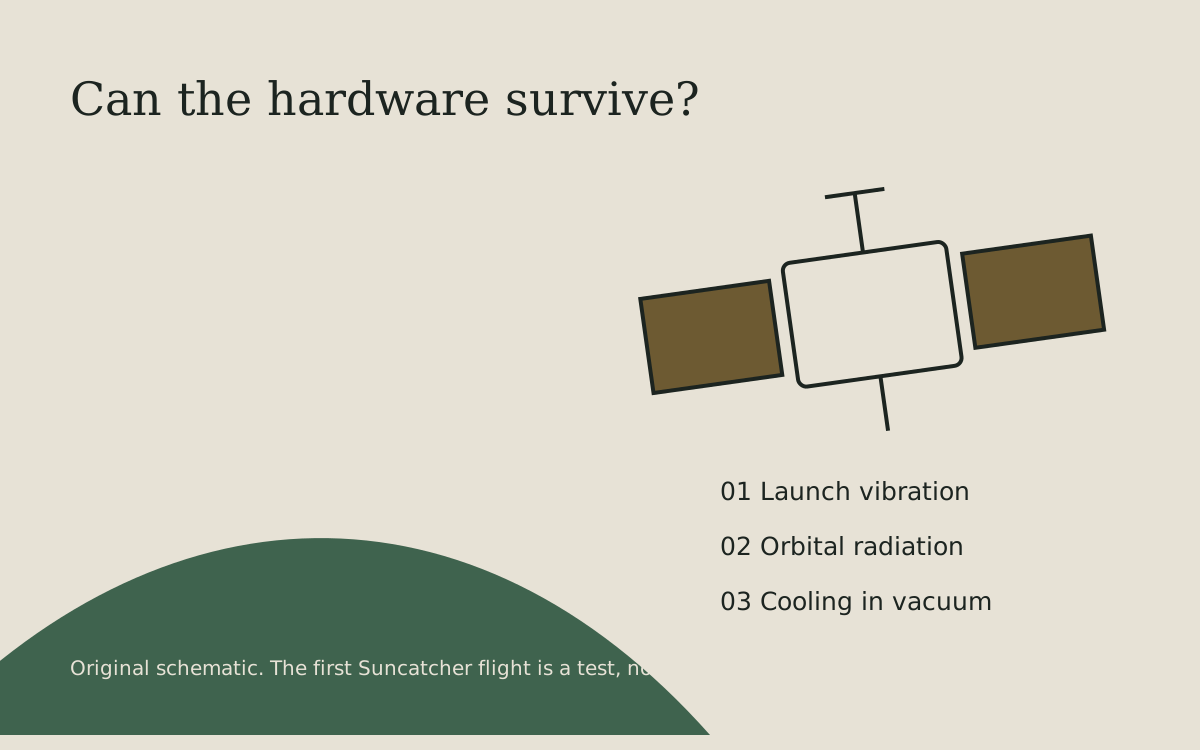
The company also sets out the engineering hurdles. It says a rocket trip to low Earth orbit lasts about ten minutes, during which the spacecraft sees sustained loads of up to 10g while individual components can see 50g to 100g. Google says ground tests showed its Trillium TPUs survived a total ionising radiation dose greater than they would receive in a five-year space mission. Those are company test results.
Cooling is another problem. In a vacuum there is no airflow, so Google is testing heat pipes and radiators. The Register stressed that radiating heat in a vacuum remains a difficult constraint. The first flight is meant to find failures and inform later missions, not to demonstrate a working data centre. Google says it plans a two-satellite laser-link test in 2027.
Sources: Google, 24 September 2026Project Suncatcher technical paperArs TechnicaThe Register