
Feature ·
Siberia
Russia says there was no accident. Then why the quarantine?
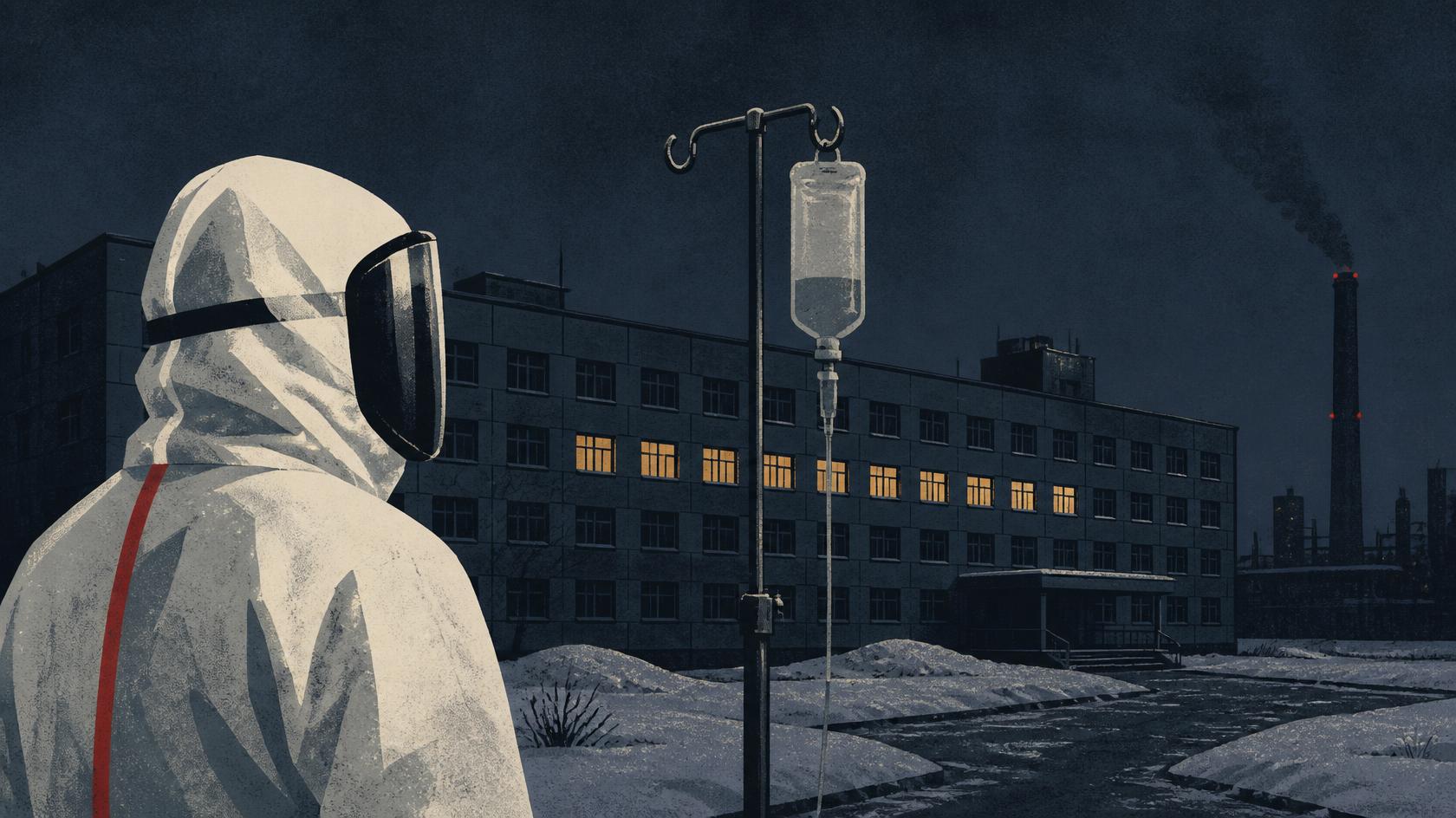
A 28-year-old laboratory technician is dead in Siberia, nearly 200 people were hospitalised and medical facilities were sealed. The state that did all that also says nothing happened. What the record shows, whether plague could outrun our antibiotics, and what would have to be true for this to become a pandemic.
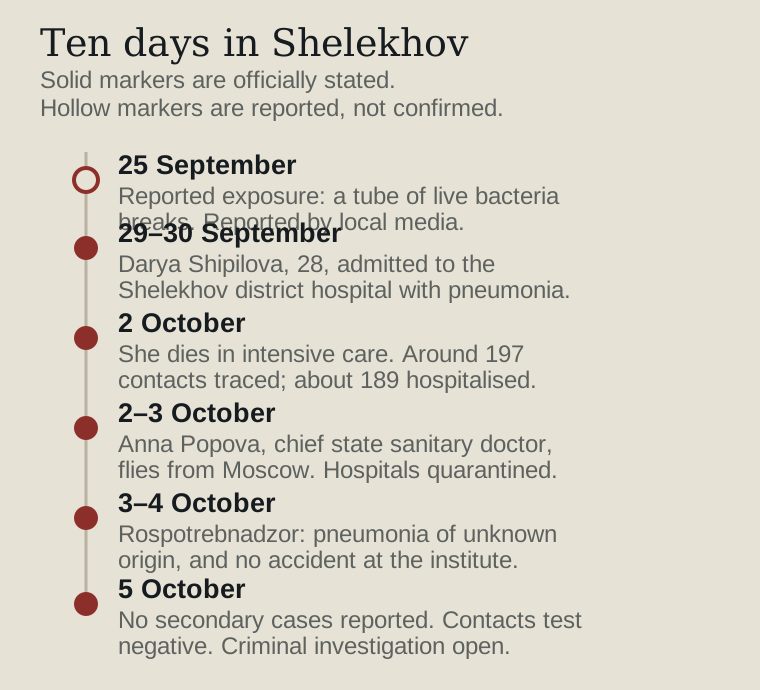
On the morning of 2 October, in a district hospital in a Siberian aluminium town, a 28-year-old laboratory technician called Darya Shipilova died of pneumonia. Within hours, the Russian state did two things at once.
It sent Anna Popova, the chief state sanitary doctor, 4,200km east from Moscow. It traced about 197 people who had been near the dead woman and put roughly 189 of them in hospital beds. It sealed medical facilities behind three-week quarantines. It ordered masks at an aluminium plant and handed protective equipment to kindergartens. It opened a criminal investigation into possible breaches of health and safety law.
And it said that nothing had happened.
Rospotrebnadzor, the federal agency that runs Russia's disease control, announced that Shipilova had died of "pneumonia of undetermined origin". A commission, it said, had found that no accident involving dangerous micro-organisms had taken place at her workplace. The regional governor, Igor Kobzev, initially declined to name any disease at all, referring only to "a particularly dangerous infection". The sanitary and epidemiological situation in the region, the agency said, is stable.
Her workplace was the Irkutsk Anti-Plague Research Institute.
The gap this story lives in
Almost everything written about Siberia this week has been an argument about one question: did she die of plague?
That is the wrong question to lead with, because it cannot currently be answered from outside Russia, and because a more useful one is available. Governments issue statements. Governments also allocate resources. Statements are cheap and can be written in a minute. Hospitalising 189 people, locking down medical facilities for three weeks and flying your most senior public health official across eight time zones is expensive, visible and hard to reverse.
When those two things disagree, the spending is the better evidence.
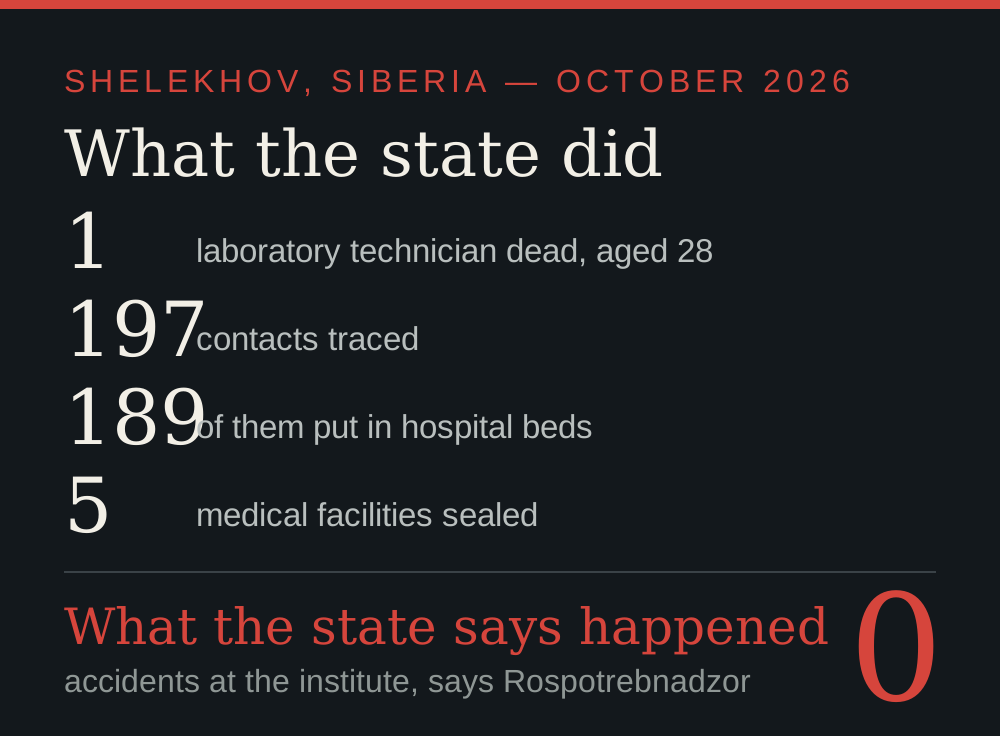
Nobody mobilises like that for undetermined pneumonia. Russia's own response is the strongest available indication that Russia's own account is incomplete. That is not a theory about a cover-up. It is an observation about what the state did, set beside what the state said, and it is the spine of this story.
There is a second contradiction inside the official account, and it is sharper. The Moscow Times, citing people around the case, reported that Shipilova told medical staff she had broken a tube containing live bacteria while handling samples, on or about 25 September. Rospotrebnadzor's commission says no accident involving pathogens occurred at the institute. Both cannot be true. One is an account attributed to the dead woman herself; the other is a finding by the agency that would be responsible if the account were correct.
And a third: Alexei Tsydenov, the head of the neighbouring republic of Buryatia, said publicly that she had died of a form of plague. He is a regional head of government, not a blogger. Two arms of the same state are on record saying different things.
Where this is
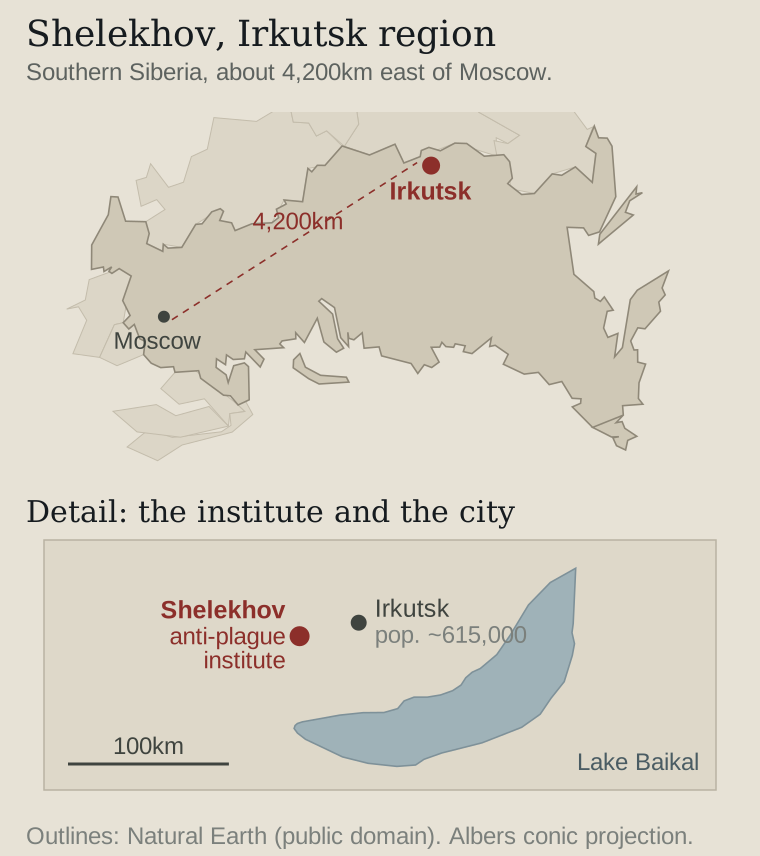
Shelekhov is a town of about 46,000 people built around an aluminium smelter, roughly 20km from Irkutsk, a city of about 615,000. Lake Baikal lies some 70km east. The Mongolian border is about 300km south. Moscow is a five-hour flight away, and the distance matters: this is not a place Russian federal officials visit casually, which is part of why Popova's arrival was read as significant.
It matters for a second reason. Irkutsk is a transport hub on the Trans-Siberian railway with an international airport serving routes into Mongolia, China and the wider Russian network. An outbreak that stayed inside Shelekhov would be a local tragedy. An outbreak that reached Irkutsk city undetected would be a different kind of problem. There is no indication that has happened. It is simply the thing worth watching.
What plague actually is, and what it is not
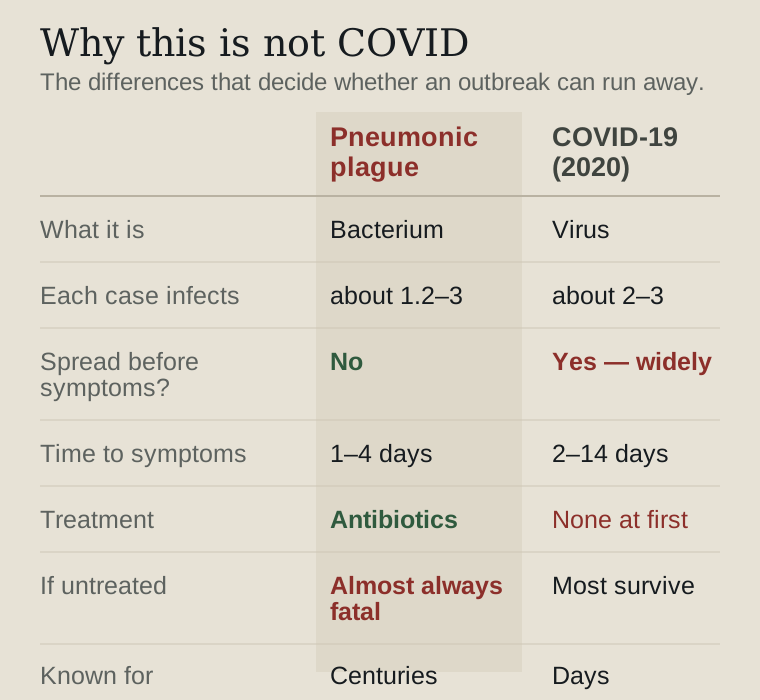
Most coverage this week has called this a virus. It is not. Yersinia pestis is a bacterium, and the distinction is the single most important fact in the story, because bacteria can be killed by antibiotics and viruses cannot.
Plague comes in forms. The bubonic form, the one most people picture, spreads through flea bites from infected rodents and does not readily pass between people. The pneumonic form settles in the lungs and does: it travels on droplets, person to person, in the way a bad cough travels. Pneumonic plague is what a laboratory accident at an anti-plague institute would plausibly produce, and it is the form that would matter.
Untreated, pneumonic plague is close to invariably fatal, and fast. Treated early with common antibiotics, it is survivable. That gap between untreated and treated is the entire public health question, and it is why "is the strain drug-sensitive?" is a more consequential question than "was it plague?"
Plague has also not gone anywhere. It is endemic in rodent populations across central Asia, Africa and the western United States, and causes cases every year. Siberia has a plague surveillance system precisely because the pathogen lives there. That is why an anti-plague institute exists in Irkutsk at all — a point worth holding onto, because it cuts against the most lurid readings of this story. The institute's presence is not evidence of anything sinister. It is evidence of a plague reservoir.
Could this become a pandemic?
This is the question readers actually want answered, and it deserves a real answer rather than a shrug in either direction. The honest way to handle it is to set out what would have to be true, and then check each condition against the record.
Five things would all have to hold.
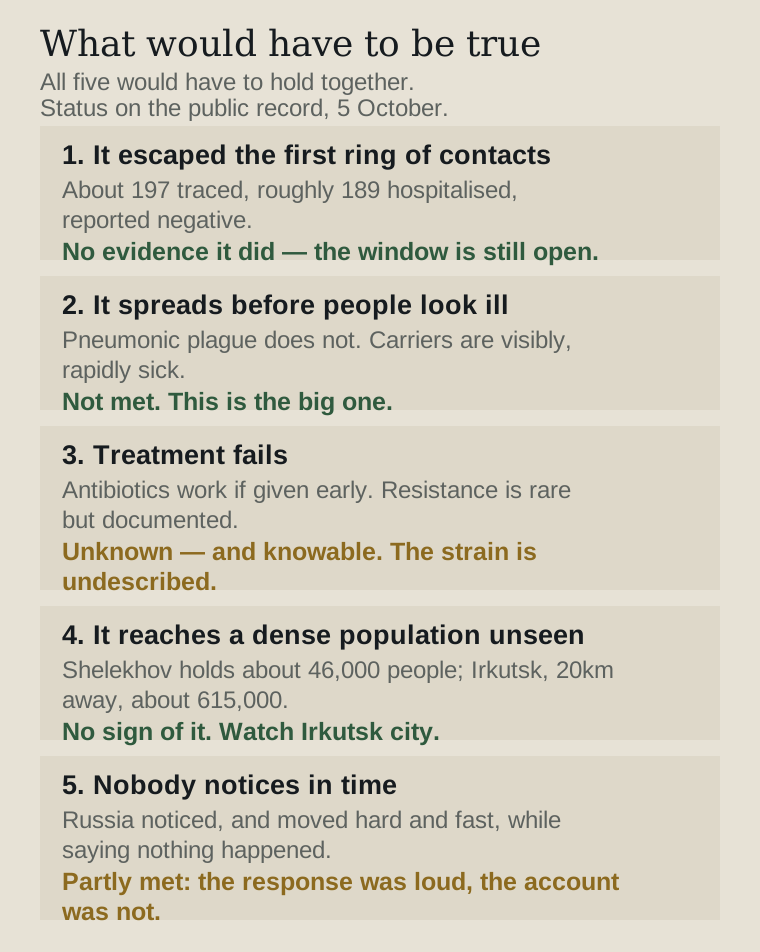
It would have to have escaped the first ring. Roughly 197 contacts were identified and about 189 hospitalised. Officials say they show no symptoms and have tested negative. Those are Russian figures and carry the discount this story requires — but contact tracing at that scale is hard to fake at the hospital level, and no independent reporting has surfaced a secondary case. The incubation window from a 25 September exposure has largely passed for the first ring. Each additional quiet day is real evidence.
It would have to spread before people look ill. It does not. This is the decisive difference from COVID-19, and it is not a close call. SARS-CoV-2 spread from people who felt fine, which is why contact tracing failed worldwide in early 2020. Pneumonic plague makes people obviously, severely ill within one to four days. You cannot carry it quietly through an airport for a fortnight. Containment that was impossible for COVID is routine for plague.
Treatment would have to fail. Here the record genuinely runs out, and this is the part of the story that deserves more attention than it is getting. More on it below.
It would have to reach a dense population unnoticed. No sign of that. Irkutsk city is the place to watch.
Nobody would have to notice in time. Russia noticed. Whatever else can be said about the official account, the response was fast and heavy.
Four of those five conditions are not met on the public record. One is unknown. A reasonable reading is that a pandemic from this incident is unlikely, and that the main residual risk is not the one the headlines are chasing.
There is a precedent that makes the point better than any model. In 2017 Madagascar had a genuine pneumonic plague epidemic: around 2,100 cases and roughly 170 deaths, three-quarters of them pneumonic, reaching the capital and forty of the country's districts. It was stopped within four months, in a country with far thinner health infrastructure than Siberia, using antibiotics and contact tracing. It did not leave the island. That is what an actual pneumonic plague outbreak looks like when it is bad — serious, deadly, locally devastating, and containable.
Could it become resistant?
This is the question a reader in 2026 should ask, because it is the one that would overturn everything above. We are two decades into a slow global failure of antibiotics. If plague joined that trend, the comfortable sentence — "plague is treatable" — stops being true, and the comparison with COVID starts to look different.
The answer is that it can happen, because it already has.
In 1995 a 16-year-old boy in the Ambalavao district of Madagascar was found to be carrying a strain of Yersinia pestis, catalogued as IP275, that shrugged off eight antimicrobials — including streptomycin, tetracycline, chloramphenicol and sulfonamides, which is to say most of what plague is treated and prevented with. It was not a laboratory curiosity. It came out of a patient.
The mechanism is the part worth understanding, because it is counter-intuitive and it is where the modern antibiotic crisis actually touches this story.
Plague did not evolve that resistance itself, grinding its way to immunity under a course of treatment. It acquired it, intact, from other bacteria. The resistance travelled on a plasmid — a loop of DNA that bacteria swap between species the way people swap phone numbers. When researchers sequenced it, the plasmid's backbone turned out to be near-identical to ones already circulating in Salmonella and in a fish pathogen, part of a family the authors described as broadly disseminated among drug-resistant organisms associated with agriculture. The likely handover point was a co-infected animal, or the gut of a flea.
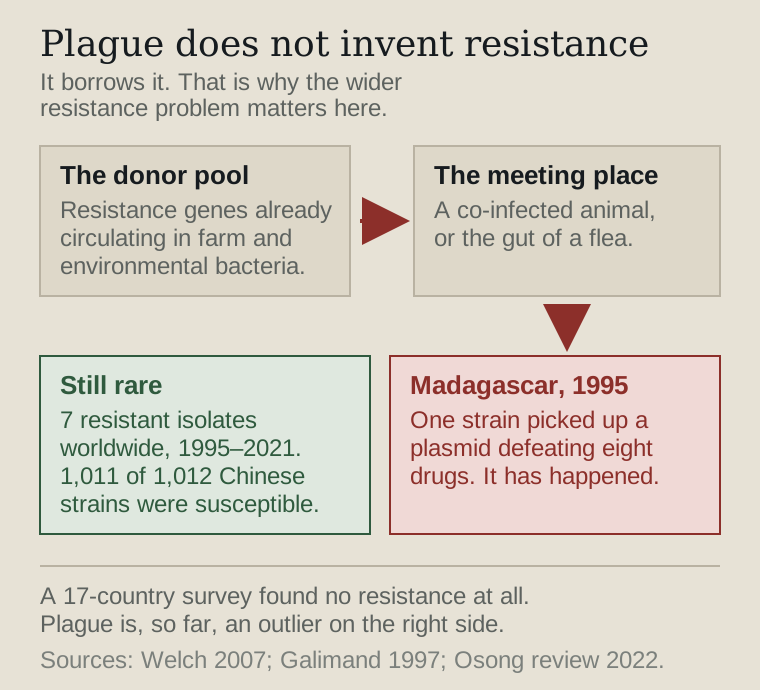
So the honest answer to "does growing antibiotic resistance matter here" is yes, and by a specific route. Plague sits in rodents and fleas, in landscapes shared with livestock and the bacteria that live in them. Every year that the pool of resistance genes in agricultural and environmental bacteria grows, the menu plague could borrow from grows with it. Nobody has to engineer anything for that to be true. It is a consequence of how antibiotics have been used on farms for sixty years.
Now the counterweight, which is substantial and should be said just as plainly. Resistance in plague remains genuinely rare. A systematic review covering 1995 to 2021 found seven resistant isolates in the entire world literature across twenty-six years. A Chinese surveillance study tested 1,012 strains against twelve antimicrobials and found 1,011 of them susceptible to all twelve. A survey of isolates from seventeen countries across the Americas, Africa and Asia found no resistance at all.
Set against the picture in hospital bacteria — where resistance is routine rather than exceptional — plague is, so far, an outlier on the right side. The reason is probably unglamorous: it spends most of its existence in wild rodents rather than in hospitals and feedlots, which is where the selection pressure is fiercest.
Two things follow for this story, and they pull in opposite directions.
The reassuring one: the base rate is low. If this was a wild Siberian strain, the overwhelmingly likely answer is that it is susceptible, and that the roughly 189 contacts given preventive antibiotics were protected by them. That preventive course is also, in miniature, another turn of the same ratchet — plainly the right clinical call, and a reminder that there is no free move here.
The unreassuring one: base rates describe populations, and this was not a random draw from a population. It was whatever was in a tube, in a collection, at an institute.
The question nobody has answered
Which brings us to the thing that has been missing from every account of this story, including the official ones.
The reassurance in all of the above rests on one assumption: that the bacterium in that tube responds to antibiotics.
Nobody has said that it does. Nobody has described the strain at all.
That assumption deserves more scrutiny here than it would almost anywhere else, and for documented reasons. The Soviet anti-plague system — the network to which the Irkutsk institute belongs — was not purely a public health body. From the 1960s it was folded into Soviet biological warfare work, first defensive and later offensive. Published nonproliferation scholarship, including work by Raymond Zilinskas, records that the programme developed antibiotic-resistant strains of Yersinia pestis. The Soviet Union did not wind up its bioweapons programme until 1992. Institutes in that system hold collections that long predate it.
None of that establishes anything about what Darya Shipilova was handling. It is not evidence of a weapons programme today, and this piece does not assert one. But it does establish that "it's plague, and plague is treatable" is a claim resting on an unexamined premise, at a facility whose institutional lineage is a specific reason to examine it.
So the question that matters most is narrow and answerable, and Russia can answer it without disclosing anything sensitive: was the strain susceptible to standard antibiotics, and were the contacts given them?
Note what kind of question that is. It is not one of the things that takes months to establish, like whether a new virus spreads before symptoms. Antibiotic susceptibility is a routine bench test, measured in a day or two. An institute that keeps a strain collection will in all likelihood already have the answer written down, from before any of this happened.
That changes how the silence reads. This is not information Russia is waiting on. It is information Russia is not releasing.
Until it is released, every reassurance in this story — including the ones in this article — is conditional.
Why Sverdlovsk is in everyone's mind
In April 1979 anthrax spores escaped from a military facility in Sverdlovsk, now Yekaterinburg, after a filter was not replaced. At least 64 people died. The Soviet government said the cause was contaminated meat, and held that line for thirteen years. Prominent American scientists found the explanation plausible and said so publicly.
In 1992 Boris Yeltsin admitted that "our military development was the cause". Yeltsin had been the regional Communist Party chief in Sverdlovsk in 1979. He had been part of the cover-up before he ended it.
Two lessons sit in that history, and they point in different directions. The first is the obvious one: a Russian official denial about a laboratory leak has a poor record, and scepticism is earned rather than cynical. The second is less comfortable and more useful: the denial was sustained for over a decade partly because credible outside experts endorsed it. Being sceptical of a government is not the same as being right. The people who got Sverdlovsk wrong were not the credulous public; they were specialists reasoning from incomplete information with professional confidence.
That is worth keeping in view this week, in both directions.
Who is amplifying this, and why
Some of the loudest reporting on this story has come from Ukrainian and Ukraine-aligned outlets. UNITED24 Media, which is connected to a Ukrainian government fundraising platform, has run it under the headline that Russia is hiding a potential pneumonic plague outbreak. Ukrainian outlets including UNN and ua.news have given it prominent coverage.
That does not make them wrong. On the central factual point — that Russia's account does not match Russia's behaviour — they are making an argument the evidence supports, and they noticed it early.
But a country at war with Russia has an obvious interest in stories that show the Russian state as careless with dangerous pathogens and dishonest about the consequences. Readers are entitled to know that, and it should change how much weight a single-sourced claim from that direction carries, in exactly the way a single-sourced TASS claim should be discounted in the other.
The test is simple and it applies to everyone: what is the evidence, and who would benefit if I believed it without checking? Applied consistently, it leaves this story resting on things that are hard to dispute — a death, a contact-tracing operation of about 197 people, quarantined hospitals, a senior official's flight, a criminal investigation, and two Russian officials contradicting each other. Those stand up regardless of which press office you distrust more.
What we do not know
- Whether the infection was plague. No independent laboratory confirmation has been published.
- What strain was involved, and whether it responds to antibiotics.
- Whether an accident occurred on 25 September. The reported account and the official commission directly contradict each other.
- Whether the contact figures are complete. About 197 is the official number; there is no outside count.
- Why five medical facilities required three-week quarantines if nothing escaped.
- What the criminal investigation is examining, given the finding that no accident took place.
What would change this assessment
We are publishing the things that would move us, so that readers can hold this piece to them.
Towards a more serious reading: a confirmed case in someone outside the traced contacts; any case in Irkutsk city; an extension or widening of quarantine after 23 October, when the current three-week measures would lapse; evacuation of medical staff; a contact who deteriorates despite preventive antibiotics; any report of a second-line or unusual drug regimen being used, which would imply the first line failed; a sudden change of story from Rospotrebnadzor.
Towards a less serious reading: the traced contacts discharged in good health at the end of the quarantine period; publication of a strain identification and an antibiotic sensitivity result, which is the single most useful thing Russia could release; independent confirmation from the WHO or a neighbouring state's health authority; the criminal investigation closing with published findings.
On the current record, the most probable story is the mundane and still terrible one: a young woman was exposed to a dangerous organism at work, nobody else was infected, and an authoritarian state that reflexively manages information has made what may have been a containable accident look like a concealment, and by not releasing the strain details it is behaving like one.
The WHO considers a global epidemic unlikely. On the evidence available, so do we. We would rather say that now, in a form we can be judged against, than wait to see how it turns out.
We will carry this forward. Each subsequent edition will record what changed, including if nothing does.
Update, : we named the outlets for the reported account and reworded the final paragraph so it doesn't state as fact what is disputed.
Sources
- Primary Rospotrebnadzor and Irkutsk region statements, via TASS and Russian state media, 2–4 October 2026
- Independent report Euronews, Has plague returned to Siberia?, 4 October 2026
- Independent report bne IntelliNews, Russia denies plague death at Irkutsk institute, October 2026
- Independent report CNN, Researcher at Russian plague laboratory dies of unknown infection, 4 October 2026
- Primary WHO, Plague – Madagascar, Disease Outbreak News, 2017
- Primary Galimand et al., Multidrug resistance in Yersinia pestis mediated by a transferable plasmid, NEJM, 1997
- Primary Welch et al., Multiple antimicrobial resistance in plague: an emerging public health risk, PLOS ONE, 2007
- Primary Yersinia pestis antibiotic resistance: a systematic review, Osong Public Health and Research Perspectives, 2022
- Primary Lack of antimicrobial resistance in Yersinia pestis isolates from 17 countries, AAC, 2011
- Independent report Zilinskas, The anti-plague system and the Soviet biological warfare programme
- Independent report Boston Globe, Soviets once denied an anthrax leak and US scientists backed the story, 2021
Spotted a mistake, or want to complain about this story? Email support@theamateur.co.uk. We correct mistakes and note the change on the story. How we handle corrections
About this feature
A 28-year-old laboratory technician is dead in Siberia, nearly 200 people were hospitalised and medical facilities were sealed. The state that did all that also says nothing happened. What the record shows, whether plague could outrun our antibiotics, and what would have to be true for this to become a pandemic.
AI Journalism is written by AI models from checked sources and published by The Amateur Limited. How we make it