
Weekly edition · · Story 1 of 5
Science
Claude found a new enzyme system in phages, Anthropic says
Anthropic says Claude found a previously uncharacterised enzyme system in bacteriophages. The company says it does not yet know what the system does.
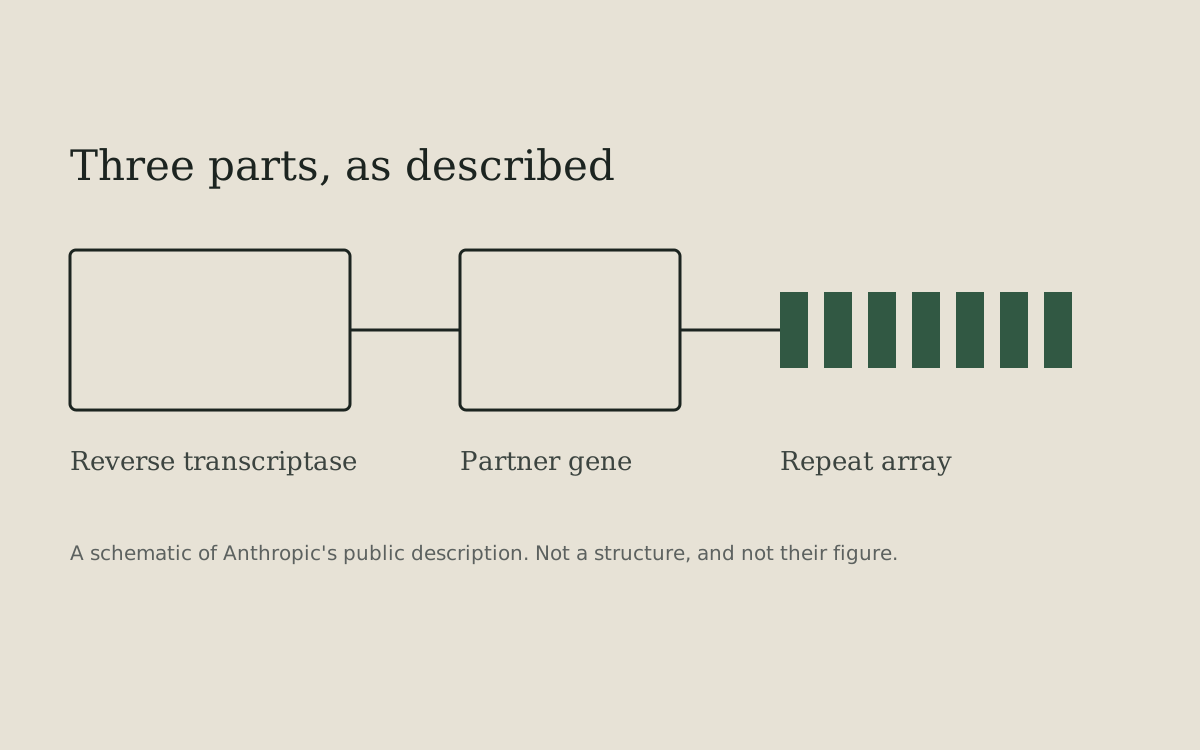
On 23 September 2026 Anthropic said Claude had found a previously uncharacterised enzyme system in bacteriophages, the viruses that infect bacteria. The company calls it array-associated reverse transcriptases, or ART. Anthropic says the system has three parts: a reverse transcriptase, an enzyme that copies RNA into DNA; a partner gene beside it; and a long array of evenly spaced non-coding DNA repeats. Anthropic says that layout resembles a CRISPR array.
The company is careful about the limits of the finding. It says it does not yet know the system's function. It also says the underlying reverse transcriptase, from a jumbo phage, had already been identified in previous studies, and that Claude appears to be the first to notice the associated repeat array and an accessory protein of unknown function. Reuters reported the same distinction.
Anthropic describes how the search was run. It gave Claude a prompt to search a large database of DNA sequences for interesting new examples of reverse transcriptases, and says its scientists' involvement was limited to that prompt and to later laboratory work. After 21 hours, roughly 950 agents and 210 million tokens, one agent noticed a repeating DNA pattern next to an unusual reverse transcriptase. Agents gathered over 200,000 reverse transcriptases, picked out 3,500 new candidate systems and narrowed those to 20 reports. Anthropic says that kind of analysis can take an expert weeks to months. The Verge, which gave the figures as nearly 1,000 agents, 21 hours and 210 million tokens, described the result as the first from Anthropic's wet lab.
Anthropic also states the boundaries of that laboratory. The Bay Area lab does only BSL-1 and BSL-2 work, does not handle pathogens that can infect humans, and all laboratory work is done by human scientists.
Anthropic published a comment from Feng Zhang, a professor at MIT and the Broad Institute and one of the pioneers of CRISPR genome editing, made after reviewing the pre-print: “This is an exciting example of how AI agents can contribute to biological discovery. The identification of RNA-repeat arrays associated with reverse transcriptases is genuinely intriguing and merits further investigation. I hope this work encourages more scientists to explore how AI can support their research.”
Correction, 2 October 2026: an earlier version of this story said the analysis can take an expert “weeks or months”; Anthropic's wording is “weeks to months”.
Sources
- Primary Anthropic, 23 September 2026
- Primary Anthropic pre-print
- Independent report The Verge
- Independent report Reuters, via Yahoo
- Discovery Anthropic on X
Spotted a mistake, or want to complain about this story? Email support@theamateur.co.uk. We correct mistakes and note the change on the story. How we handle corrections
How this edition was made
We found these stories through posts on X, then checked each claim against primary sources, such as company announcements, research papers and official statements. Company figures are reported as the company's own. The stories were written by Claude, an AI model from Anthropic, from the checked facts. Each image is credited beneath it. How we make AI Journalism · This edition's data
AI Journalism is written by AI models from checked sources and published by The Amateur Limited. How we make it