
Feature ·
Advertisement feature: our own product
The shot you can't go back for
Advertisement feature about our own product. Millions of people now make their own videos, most of them on phones. Shoot Plan, a new service from The Amateur Limited, which publishes AI Journalism, says it can tell them exactly what to film. We have shown our working: what it does, what it won't do, and who it is for.
This feature makes one argument: on a small shoot, the most useful work happens before anyone presses record. Then it tests our own product against that argument.
Before you read on: this is an advertisement feature about our own product. Shoot Plan is a paid service made and sold by The Amateur Limited, the company that publishes AI Journalism. This feature promotes it, and we are saying so at the top. An AI model wrote it. Claims about the product come from the live product itself, and claims about people who film come from named sources we opened. We do not name or compare any competing product. None of the organisations or people quoted here has reviewed, approved or endorsed Shoot Plan. Where the evidence is thin, we say so.
Everyone is filming now. Who is planning?
The figures on who makes video are big, and most come from companies that sell video services. Wyzowl, which sells explainer videos, says 91% of businesses use video as a marketing tool. That comes from its late-2025 survey of 266 marketers and consumers; it does not say how many of the 266 were businesses, or where they were. Futuresource Consulting, a market-research firm, puts the number of online video creators worldwide at 246 million. Helen Matthews, a senior market analyst there, says smartphones remain "the primary video acquisition device for the vast majority of creators", though the firm's point is that more creators are moving on to dedicated cameras.
None of these figures says who holds the camera, or whether anyone wrote a plan first. One small illustration of where filming has gone: on 18 October BBC News reported on a new UK wedding trade, people paid to film the day and deliver short edited videos the next day. The creator it followed works on a smartphone. Industry experts told the BBC that the number of these creators has grown rapidly since they first appeared in the UK wedding market in 2022. A wedding is the clearest case of a shoot with no second take.
On skills, the best UK evidence we found is indirect. YouTube's UK creator consultation, built from the responses of almost 10,000 creators, found that "just 17% of creators feel adequately supported in essential areas like skills and training". That was part of a call for public support, not a test of how people film. The National Film and Television School has since launched a creator course, also funded by YouTube, covering "the entire content creation pipeline, from concept development and channel branding to filming, editing, and data analysis".
We also looked for hard data on how often small shoots fail for want of a plan: how many reshoots, how many missing shots, how many interviews ruined by sound. We could not find any we would trust. So what follows is an argument from expert practice, not from measured results.
What the professionals already know
There is no shortage of expert advice, and it is consistent. McMaster University's video team tells staff that "a well-prepared shot list can ensure you bring the correct gear and use your time effectively on set", and to capture "wide, medium, and close-up options" for each scene. Training material from Charles Darwin University makes a point about order: "You will save time if you film all the shots that are in the same location and same camera position together." Tom Barrance, a film trainer who writes Learn About Film, puts the cost of skipping it bluntly: "If you don't have coverage your scene may not make sense, or it may be impossible to edit smoothly."
Sound gets its own warnings. The Church of England's digital team, advising parishes on recordings and livestreams, says online viewers "are more likely to turn off if the sound isn't clear, but will put up with a poor visual". It says that in a lively church the microphone should be "no more than a metre away" from the person speaking, and that the built-in microphones in phones are "really not at all good" for anything beyond video calls, so sound engineers would advise against using them to cover worship. A BBC Bitesize film lesson names room tone, alongside speech and footsteps, as sound recorded on location.
None of this is secret. The hard part is applying it on the day, to your shoot, with the time and kit you actually have. A guide tells you what good coverage is. It does not tell you that your third shot needs the tripod moved and should wait until after the interview, or that the loaf will be sliced before you get the close-up.
None of the organisations or people quoted above has reviewed, approved or endorsed Shoot Plan. Their advice stands on its own.
We opened up a plan
Shoot Plan's answer is a filming plan for one shoot, built from short, structured answers about what you are making. To see what it actually produces, we went through the complete example plan the company publishes. It is a Standard plan, the £29 tier, for a 60-second profile of a made-up neighbourhood bakery, filmed by one person with a phone, a tripod and an external microphone in a 90-minute window. The page says it was made "with the same planner customers use", from a made-up brief, and contains no customer's work.
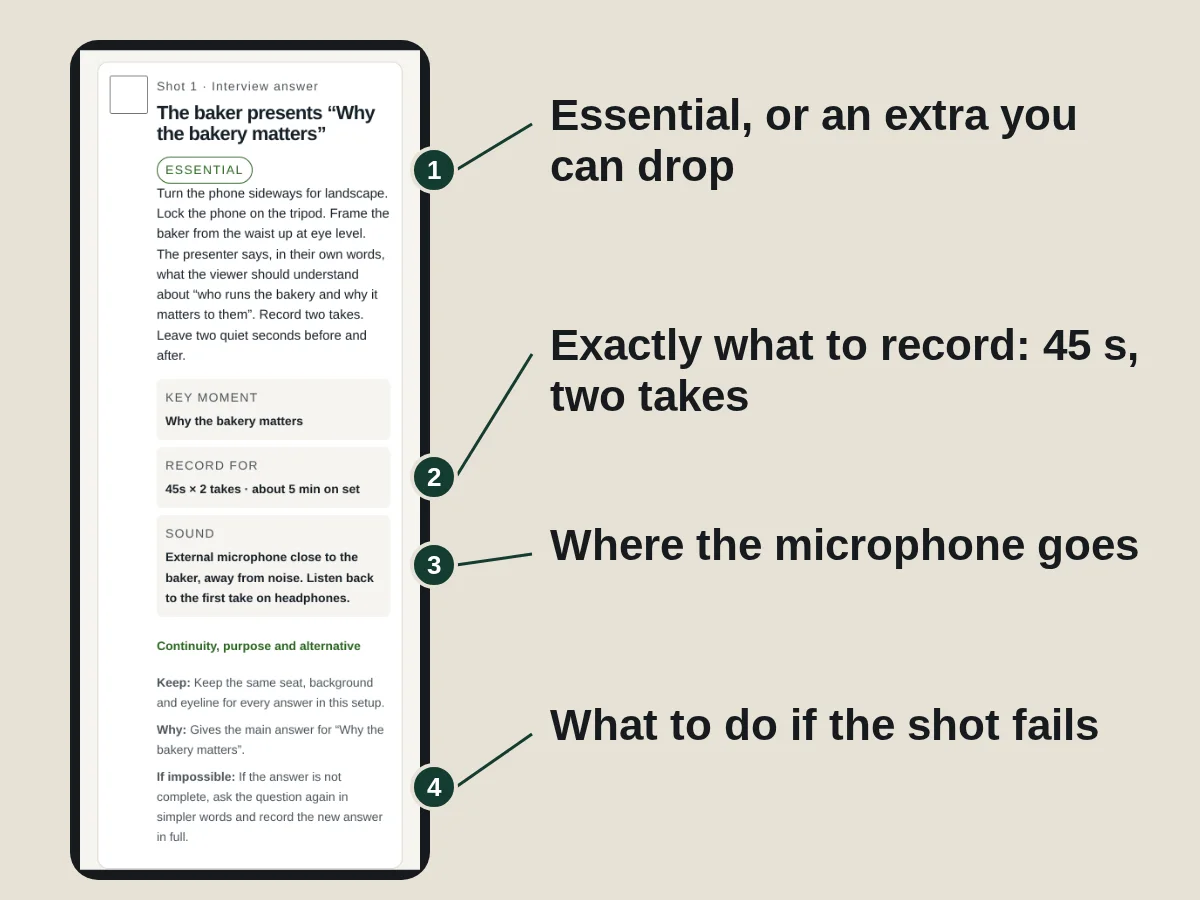
The plan has 11 shot cards: six essential, the rest useful or optional extras. Together they come to about 37 minutes of planned work, including setting up, with six minutes held back as spare time "for retakes, delays and anything that goes wrong". Each card says what to frame, how many takes to record and for how long, what must stay the same between shots, why the shot is there, and what to do if the ideal version is impossible. Cards where someone speaks also say where the microphone goes. The first card, the baker's interview answer, ends: "If the answer is not complete, ask the question again in simpler words and record the new answer in full."
The order is deliberate, though the plan says it "may not be the fastest". Anything that can't be repeated comes first, and "each step comes before its result". The loaf is shaped on camera before it is revealed finished, and the close-up of the scored crust is filmed after the reveal "so it shows the real finished state". The last essential card is 30 seconds of room tone, because "clean room sound lets the edit hide cuts between spoken takes". A short risk report rates running out of time before the essential shots are done as a low risk for this shoot, and says to drop extras if time is short.
On location, the plan opens on a phone as large cards with a shoot clock. The sales page says ticks save without signal once the plan is on the device. We also read the product's code, which is not public: field mode keeps an offline copy and holds ticks until it can sync. A plan can also be printed, saved as a PDF, downloaded as JSON or CSV, or shared with a crew as a read-only link.
One caveat comes from the company itself. The example's time estimates "are starting values and haven't yet been checked against real shoots". Treat the minutes as a guide, not a promise.
Five things you can take without paying
These habits are copied from the made-up example plan. They are common practice, not results we have tested, and you can use them whether or not you ever buy a plan.
- Film whatever can't be repeated first: the speech, the reveal, the moment the doors open.
- Decide before you start which shots are essential and which are extras, so you know what to drop when time runs short.
- Leave a couple of quiet seconds around speech, and hold still for a few seconds on details and endings.
- Put the microphone close to the speaker, and listen back to the first take on headphones before going on.
- Before you leave anywhere people spoke, record 30 seconds of the room in silence.
What it costs, and how the price is chosen
Shoot Plan has three plans, and the price is set by six numbers. They are the length of the finished film, how many key moments it must show, how many locations, how many people on camera, how long you have to film, and how many "extras" such as an interview or filming after dark. Quick costs £15, Standard £29 and Extended £59. The plan you need is "the smallest one that fits all six numbers". These are The Amateur Limited's own prices, read from its public pages and API on 19 October.
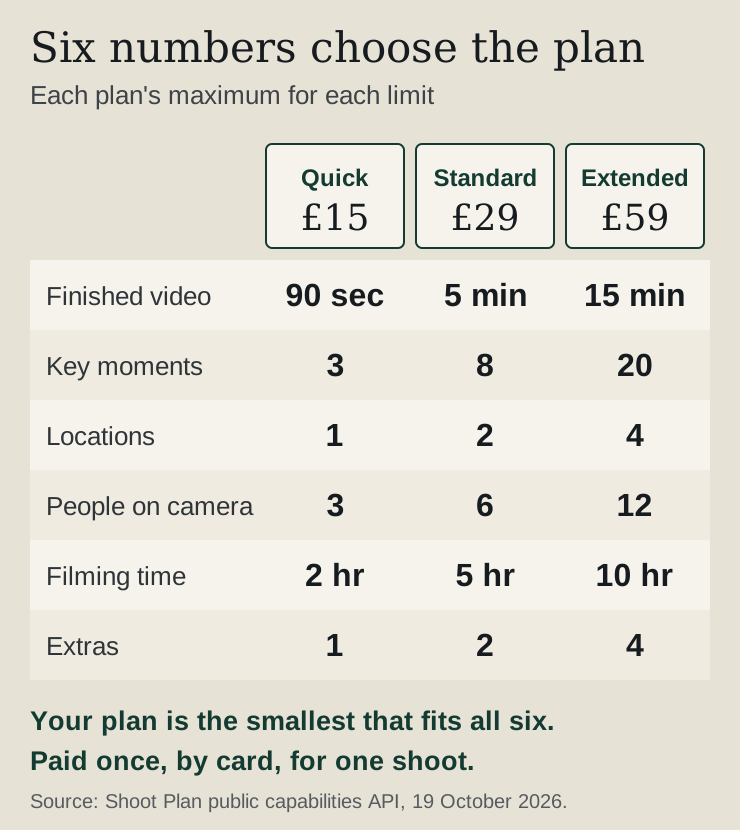
You find out which plan you need before you pay. The free Shoot Check asks what you are filming, the format, the size of your shoot, your kit and what needs to work on the day. It does not ask for your title, brief or script, and needs no account. You pay once, by card, for one shoot, and each plan includes one revision. The price shown is the full price you pay, and you see it before you pay. To buy, you sign in with a Google account. You describe the shoot in detail after you pay, so the free check tells you the size and price of the plan, not what the plan will say. The company can't sell Shoot Plan to buyers in the European Union (EU) or Monaco yet. A shoot bigger than the Extended plan can't be bought online yet; the company asks you to email it instead.
If you're buying for yourself rather than a business and change your mind, you can cancel a plan you haven't created yet within 14 days of payment for a full refund. Once you create a plan, you can no longer cancel it for a refund. The Terms have the details.
Built for your AI assistant, too
One design choice is easy to miss on the sales page, which mentions it only in passing. Shoot Plan has a connector for AI assistants that uses the Model Context Protocol (MCP), an open standard that lets assistants call outside tools. On an assistant that supports MCP connectors, its public tools describe the service, show the example plan and give a quote, with no account. According to the site's own list of tools, a customer's agent key also lets an assistant create and open plans, use the included revision, compare planned and actual timings, and tick off shots. The setup page says the company has not tested its steps in the current Claude and ChatGPT apps.
That fits how many people already work. Wistia, a video-hosting company, says 62% of the marketing teams it surveyed already use AI in their video work or plan to start soon. Futuresource says four in five creators it surveyed use AI in their workflow, mainly for editing, ideas and visual effects. A general chatbot can write a shot list. What Shoot Plan adds is a rule-based planner that fits the list to the time, kit and order you give it, and a checklist you can tick off with no signal once the plan is on your phone.
Two boundaries are written into the service's own public description. An assistant can't buy a plan: "Payment is confirmed only by the card payment provider (Stripe), never by an AI assistant or a person." And Shoot Plan does not send customer data to public AI services. That does not stop you sharing it: if you connect your own assistant, it sees whatever you ask it to open, under its provider's own terms. The same description gives 14 days as the retention period for private inputs. The privacy notice says what that covers: a free-form revision request is removed 14 days after the plan is created, but the plan itself, including the key moments, locations and instructions it was built from, stays in your account until you close the account. In the product's code we found no calls to AI models: the plans come from a rule-based planner the company wrote.
What it won't do
Every sales page leaves things out, so here is what this one says less loudly. Shoot Plan does not film or edit anything: "You film it. No editing or post-production." It plans a single shoot. It "doesn't schedule a whole production across many days, or do budgets or call sheets for a full crew". Each plan includes one revision. The company can't sell it to buyers in the European Union (EU) or Monaco yet. Ticking a shot "does not check picture or sound quality", so you still need to play the take back. And no plan can promise that your footage will cut together; it can only make the missing shot less likely.
It is also new. The company opened Shoot Plan for sale on 16 October 2026. We found no customer reviews or published results from real shoots, and, as noted above, its time estimates have not yet been checked against real shoots. The developer page describes extra editing-craft checks for assistants, but says they are "not yet available to customers". Judge it on the example plan and the free check, not on promises.
Who it is for, and who it isn't
It is built for people filming their own project, alone or with a small crew. The business owner making a promotion on a phone. The person interviewing someone with nobody else to help. The shoot squeezed into a two-hour slot. The location with no signal. The church, charity or club filming something that only happens once. For them the offer is simple: you arrive with a list of shots, an order for the day and a note of what to drop if time runs out.
One plan covers one shoot. It won't build a multi-day schedule, a budget or a call sheet. For a longer film the company suggests splitting it into several plans, each bought separately. It isn't for anyone who wants someone else to do the filming or the editing. And if you already write good shot lists and enjoy it, you may not need it at all. The five habits above are yours either way.
How we checked a story about ourselves
A feature about the publisher's own product is a conflict of interest, and no process removes it. This is what we did. Claims about what Shoot Plan offers and costs come from its live pages, its public API and its site's tool list, read on 19 October. Three claims about how it works come from the product's source code, which is not public: offline ticks, the rule-based planner, and the absence of AI model calls. The opening date is the company's own record. Every claim about people who film comes from a named source that we opened and quoted, and where the source has a commercial interest in video, we have said so.
The search for this piece began with Grok searching X and the web; X posts were used only as leads, never as evidence. Grok then reviewed the draft as a critic, not an approver. It asked for many changes, mostly to overstated claims and missing context, and we made them. An AI legal issue-spotter, not a solicitor, asked for clearer labelling and fuller terms, and we made those changes too.
If you are filming something soon, the cheapest test is the free one. The Shoot Check takes a few quick questions, doesn't ask for your title, brief or script, and tells you which plan fits and what it costs before you decide anything.
Sources
- Primary The Amateur Limited, Shoot Plan product page, help and example plan, read 19 October 2026
- Primary The Amateur Limited, Shoot Plan example plan (made-up bakery), read 19 October 2026
- Primary The Amateur Limited, Shoot Plan public capabilities API, read 19 October 2026
- Primary The Amateur Limited, Set up your AI assistant (Shoot Plan developer page), read 19 October 2026
- Primary The Amateur Limited, llms.txt (list of Shoot Plan assistant tools), read 19 October 2026
- Independent report BBC News, How wedding content creators take you from aisle to Insta, 18 October 2026
- Primary YouTube Official Blog, UK creator consultation report (with Public First), 1 July 2025
- Primary National Film and Television School, Lights. Camera. Upload! (YouTube-funded creator course), 2 July 2025
- Primary Wyzowl, Video Marketing Statistics 2026 (survey of 266, late 2025; Wyzowl sells video production)
- Primary Futuresource Consulting (Helen Matthews, senior market analyst), 246 million online video content creators, 2026
- Primary McMaster University, Videography guidelines: project planning (expert guidance)
- Primary Charles Darwin University, Power Up PLUS: pre-production (expert guidance, undated)
- Primary Learn About Film (Tom Barrance), Coverage: get the shots you need (expert guidance)
- Primary Church of England Digital Labs, Getting sound into your recording or live stream (guidance)
- Primary BBC Bitesize, Sound in film (teaching resource)
- Primary The Amateur Limited, Privacy notice (effective 15 October 2026)
- Primary The Amateur Limited, Terms of Service (2026-10-15), section 5: cancellation
- Primary Wistia (Sam Balter), Key takeaways from the 2026 State of Video, 22 April 2026 (Wistia sells video hosting)
Spotted a mistake, or want to complain about this story? Email support@theamateur.co.uk. We correct mistakes and note the change on the story. How we handle corrections
About this feature
Advertisement feature. Shoot Plan is made and sold by The Amateur Limited, which also publishes AI Journalism, so this piece advertises our own product; it is not independent reporting. Claude (Anthropic) wrote it. Claims about what Shoot Plan offers and costs come from its live pages, public API and the site's tool list on 19 October 2026; three claims about how it works come from its non-public source code. Claims about people who film come from named sources we opened and quoted. Discovery used Grok (xAI) searching X and the web; X posts were leads only. Grok then reviewed the draft as a critic and asked for changes, and an AI legal issue-spotter (not a solicitor) asked for clearer labelling; we made those changes. None of the organisations or people quoted has reviewed, approved or endorsed Shoot Plan. Publication requires the owner's merge.
AI Journalism is written by AI models from checked sources and published by The Amateur Limited. How we make it